Why ABC Sales AI Clients Succeed When Others Don't
After helping 800+ businesses deploy AI inside their daily workflow, the pattern is clear. The clients who succeed don't treat AI as a chatbot. They treat it as a teammate. And Stanford just confirmed why this approach works.

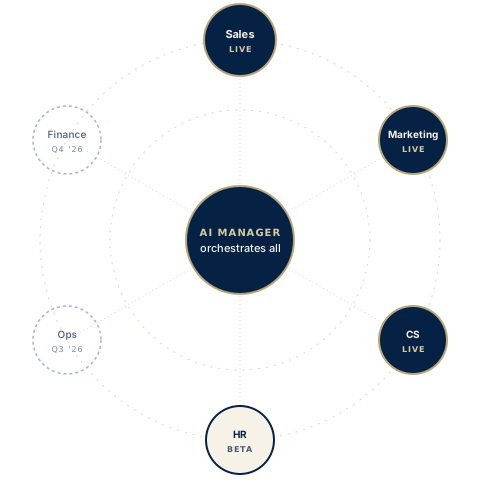
Why do ABC Sales AI clients succeed when so many other AI projects fail?
That is the question I've been wondering after seeing many clients switch over.
After helping over 800 SMEs across Malaysia and Singapore put AI into their daily workflow, I can tell you the answer is not what most people think.
It is not because we have a better model. It is not because we use GPT instead of Gemini, or Claude instead of Qwen. It is not because our AI is "smarter" than someone else's chatbot.
It is because we run a different kind of project.
Other vendors sell you a chatbot and walk away. We do the opposite. We sit with the client and listen to the actual issue first - what is leaking, what is breaking, what their staff hate doing. We design a personalised solution around their real workflow, not a generic template. We test and deploy with them inside the team setup they already have, so nothing breaks. And we walk them through the change management - because the team has to actually use the system for it to work.
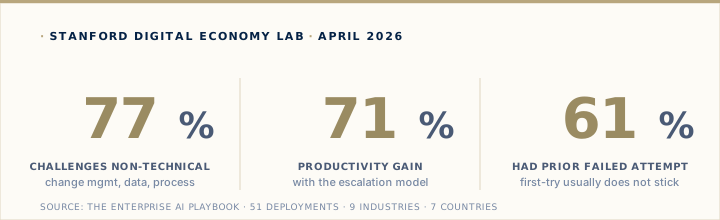
Stanford's research backs this up directly: 77% of the hardest AI challenges are not technical at all. They are organisational - change management, data quality, process redesign. The model is the easy part. The deployment around it is where almost everyone fails.
That difference compounds. Here is what we see across 800+ clients.
The clients who win share four habits. The clients who lose make the same four mistakes.
And in April 2026, Stanford's Digital Economy Lab quietly published research that confirmed almost exactly what we see every week.
The paper is called The Enterprise AI Playbook: Lessons from 51 Successful Deployments. They studied 51 successful AI implementations across 41 organizations, 9 industries, and 7 countries. The conclusion was direct: the technology works. The challenge is everything around it - process, workflow, leadership, data, adoption, execution.
In other words: most AI projects do not fail because the AI is stupid. They fail because the business has not designed the workflow properly.
That is the real insight. And it explains exactly why our clients win.
Here is the pattern.
1. Our clients stop treating AI as "a chatbot."
Every week someone asks me, "Is ABC Sales AI just another chatbot?"
My answer is simple. No.
Calling it a chatbot is like calling a chef "someone who cuts vegetables." Technically yes, a chef can cut vegetables. But that is not the value.
The clients who fail with AI think the goal is "auto-reply." Customer asks question, bot replies. End of story.
The clients who succeed think bigger. The job is to move the customer forward. So our AI does not just reply. It responds to leads instantly. It asks the right qualifying questions. It follows up when the team forgets. It books appointments. It collects customer information. It reminds prospects. It escalates to a human when needed.
That is not a chatbot. That is a sales workflow running on AI.
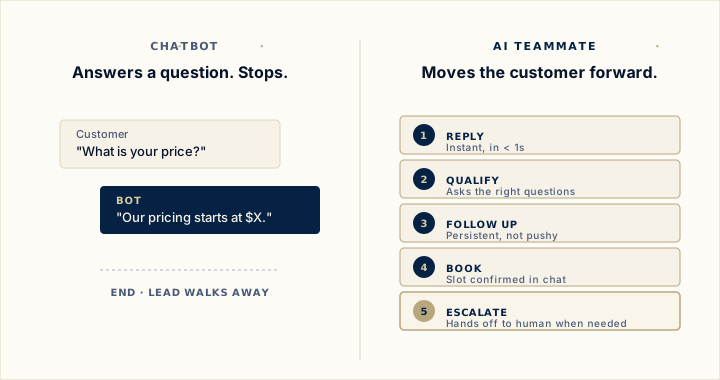
This is the first pattern. Stop thinking "auto-reply." Start thinking "AI teammate inside the sales pipeline."
2. Our clients design the workflow before they design the AI.
Stanford found something powerful in their study. 77% of the hardest AI challenges were invisible and intangible costs - change management, data quality, process redesign. Not the model. Not the prompt. Not the API.
This matches what we see exactly.
A typical SME funnel leaks money in boring, predictable places:
- Leads ask questions at night when the salesperson is asleep
- Leads ask during the weekend when nobody is checking
- Leads say "interested" but no one follows up properly
- Leads book a trial, come once, then disappear
- Leads ask for pricing but staff reply too late
- Leads are hot for the first 5 minutes then cold by the time someone replies
This is the real expensive problem. Not "no AI." Just broken follow-up at every stage of the funnel.
Our successful clients see this clearly. Before they ask "what AI tool should we buy?" they ask "where exactly are we losing leads, and which steps need to never be late?"
They map the workflow first. Then they put AI into the gaps.
The clients who fail buy a tool, plug it in, then wonder why nothing changed. They never asked the workflow question.
Stanford also found that 61% of successful AI projects had at least one prior failed attempt. That number tells you something important. The first try usually fails because the team is still thinking "tool first." The second try succeeds because by then they have learned to think "workflow first."
We try to skip step one for our clients. We design the workflow with them in our onboarding. That is why their first deployment lands.
3. Our clients use the escalation model. Stanford says it gives 71% productivity gains.
This is one of the most important findings in the Stanford paper, and it matches what we have been telling clients for two years.
Stanford calls it the escalation model - where AI handles most routine tasks automatically, but humans step in for exceptions. This model delivered a median productivity gain of 71% in their studied deployments.
71%. That is not a small number.
Most business owners make one of two mistakes here.
The first mistake is wanting AI to do everything with zero human control. That is dangerous. Customers feel it. Staff lose trust. The system overreaches and embarrasses the brand.
The second mistake is forcing humans to approve every single AI action. That kills the productivity gain Stanford documented. You may as well not have AI.
The practical answer is in the middle. Let AI handle the normal work. Let humans handle the unusual cases.
For our clients, this looks like:
- Customer asks for business hours - AI replies
- Customer asks for pricing - AI explains
- Customer wants to book an appointment - AI helps schedule
- Customer sends a common objection - AI follows the script
But:
- Customer is angry, confused, or high-value
- Customer asks something legally sensitive
- Customer is about to walk
That is when the AI escalates to a human, with the full context of the conversation already loaded.
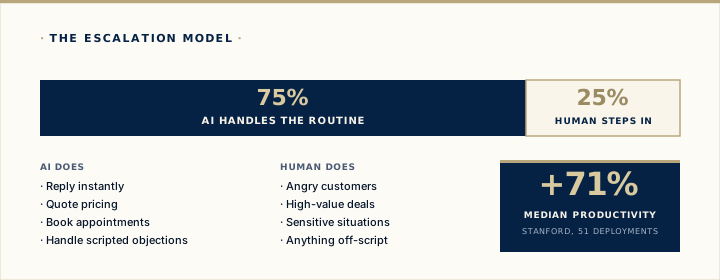
That is how AI should work in a real business. Not "replace everyone." Not "human approve everything." But: AI handles the routine, humans handle the important exceptions.
This is the third pattern. Our clients do not run AI as a replacement for staff. They run it as the layer underneath that lets staff focus on the moments that actually matter.
4. Our clients meet customers where they already message. Not on a website.
This is where many SME AI projects die before they start.
The chatbot industry has trained business owners to think AI lives on a website. A little circle in the bottom right corner. Click to chat. Hope someone uses it.
That is too small. And for most SMEs, it is the wrong battlefield.
For SMEs, the real customer conversation is happening on WhatsApp. On Instagram DM. On Messenger. On LINE. On Telegram. Wherever the customer already texts you.
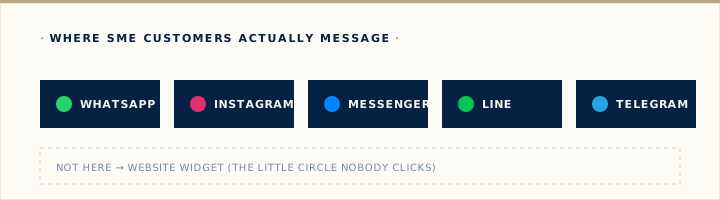
Our successful clients understand this. They put the AI on those channels, not on a website widget. Because that is where the leads are. That is where the urgency lives. That is where reply speed actually wins or loses the sale.
A good AI salesperson on those channels does not only answer "What is your price?" It also asks: "What are you looking for?" "When do you want to start?" "Do you want to book a slot?" "Would you like me to send you the package details?" "Can I help check which option suits you?"
That is the difference between a chatbot and an AI sales teammate. A chatbot answers questions. A teammate moves the conversation forward.
Stanford's broader point applies here. The technology is not the bottleneck. Where you deploy it is. And SMEs who deploy AI on the channels their customers already use see results their competitors on websites never get.
The clients who lose are the ones who keep waiting.
A lot of business owners are still watching from the side. They say:
- "Let's wait first."
- "AI is still new."
- "My business is not ready."
- "My staff can handle it."
- "My industry is different."
- "My customers still prefer human."
I understand the instinct. But let's be honest.
Your customers already expect fast replies. Your competitors are already trying new tools. Your staff are already stretched. Your leads are already leaking. And your business already has repetitive work that AI can clearly help with.
The question is not whether AI is coming. It is already here.
The question is whether you will treat it as a toy, or whether you will redesign part of your business around it.
Stanford's research makes this clear: successful AI deployment is not about hype. It is about business value, process redesign, and measurable outcomes.
That is the part business owners should pay attention to. Not the drama. Not the model wars. Not the LinkedIn hype. The real question is: where can AI reduce delay, inconsistency, missed follow-up, and wasted manpower in your business?
Our clients started there. That is why they win.
So why do ABC Sales AI clients succeed when others don't?
It comes down to four things, and Stanford just confirmed all of them:
- They stop thinking "chatbot." They think "AI teammate inside a sales workflow."
- They design the workflow first, then put AI into the gaps that leak revenue.
- They use the escalation model - AI handles routine, humans handle exceptions. Stanford measured this at 71% productivity gain.
- They deploy on the channels their customers already use, not on a website nobody clicks.
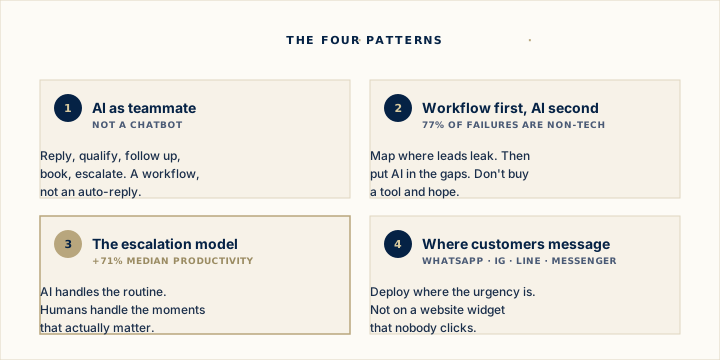
That is the playbook.
It is not magic. It is not about which model is best. It is not about who has the cleverest prompt.
It is about deploying AI inside the actual workflow of an actual business, with a clear plan for when humans step in.
And it is about the work most vendors skip. Other people sell a chatbot and disappear. We listen to the client's issue, design a personalised solution, test and deploy it with their team in their own workflow, and stay with them through the change management. That is the difference between an AI tool that gets cancelled in 60 days and an AI teammate the business cannot imagine running without.
If your offer is bad, AI will not magically make people buy. If your process is broken, AI may expose the problem faster. If your team does not know what to say, AI needs proper guidance.
But if you already have leads, customers, inquiries, appointments, FAQs, and repetitive follow-up work, then AI can become a serious advantage.
Because business growth is not only about working harder. Sometimes growth comes from removing the bottleneck.
For most SMEs, the bottleneck is the same: too many conversations, too little follow-up, too slow response time, too much dependency on tired humans doing repetitive work.
That is exactly what we remove.
That is why our clients succeed.
The future is not just AI that talks. The future is AI that helps you operate. Stanford agrees. And our 800+ clients have been seeing it work, week after week, for years.
Meng Teck
Co-Founder at ABC Sales AI. Building AI teammates that work inside SME workflows.